Rachel Valfer Sills of The Qadim Ensemble has spent much of her life following a musical thread — from the Ladino songs she loved as a girl to melodies that have traveled across centuries, languages and cultures. With the release of the ensemble’s new album, Entre Las Huertas, she reflects on the Sephardic women who carried these songs forward, the cultures that shaped them along the way and why this music remains a living tradition. It’s a story about memory and longing, but also about what happens when we tend the threads we inherit and pass them on.
The Woven Cord
By Rachel Valfer Sills
I was 22, living in Israel, half-asleep one morning when a song drifted in from somewhere outside — Shecharchoret. I sat up startled – I knew this song but not in Hebrew!
I had grown up listening to something similar, but in Ladino, or Judeo-Spanish – Morenika a Mi Me Llaman – a song I’d loved since girlhood. The melody and lyrics were nearly identical, but here it was transformed: sung in Hebrew in the raw, blood-and-soul voice of Zohar Argov, the Yemenite singer who first broke Mizrahi music into the Israeli mainstream.
I realized I was hearing a modern Israeli version of a song whose roots stretched back to the juderias, the pre-expulsion Jewish quarters of Spain, and I was deeply moved. Here, these old musical traditions weren’t relics, preserved in folk ensembles and academic archives. They were raw material – still alive, still being remade into popular music, still finding new voices. I saw the song, passing from Hebrew into Ladino, and then back into Hebrew again, renewed.
But the loveliness didn’t stop there! The Ladino lyrics themselves echo the Song of Songs; “don’t hate me because I am dark…. I am dark and beautiful”. And suddenly I could see the whole cord woven across centuries: King Solomon in his palace, composing his aching poem of longing; possibly a woman in medieval Spain, centuries later, longing for adventure and writing, “the sailors call me the dark one; if they call me again, I’ll go with them”, and Zohar Argov, decades after that, singing the same yearning into a Tel Aviv nightclub.
That thread ran all the way down to me — an American woman lying in bed in Israel, tied to Solomon and the sailor’s woman and everyone in between by nothing more than a melody and its longing. I lay there as the sun came in, and I cried. In that moment I knew that I would spend a good part of my life tending this thread — illuminating it, celebrating it and passing it forward.
A Garden of Delight
As a girl studying piano, I only wanted to play the harmonic minor and the phrygian — scales that lie at the heart of Middle Eastern music, and of the older, non-Germanic modes of Eastern Europe so common in Ashkenazi Jewish music. My mother’s side of the family were musicians from Eastern Europe; my great-grandfather was a klezmer musician who performed in Eastern Europe alongside Turkish, Romani, and other musicians with whom he traded tunes and motifs freely, each culture absorbing the others’ music into their own.
These shared scales or modes that occur in Eastern European music are also found with variations across borders, in Central Asia and in the Middle East and North Africa. When I moved to Israel after college, my ears were flooded with the beauty of these familiar modes (called maqamat in the Arabic system), and many more unfamiliar. I felt like we had walked into a garden of delight.
Then came the harder question: which tradition would I actually study? Persian? Azeri? Arabic? Turkish? Over time, I have tasted and loved the flavors of all of them. But I keep returning to Ladino, – a sweet repertoire with the rare ability to hold maqam, folk rhythms, and even sometimes dip into Western harmony when it serves the song.
These melodies braid together motifs from Greece, Turkey, Bulgaria, Romania, and the Levant, living proof that political borders are theoretical constructs and beauty never bothered to read the map.
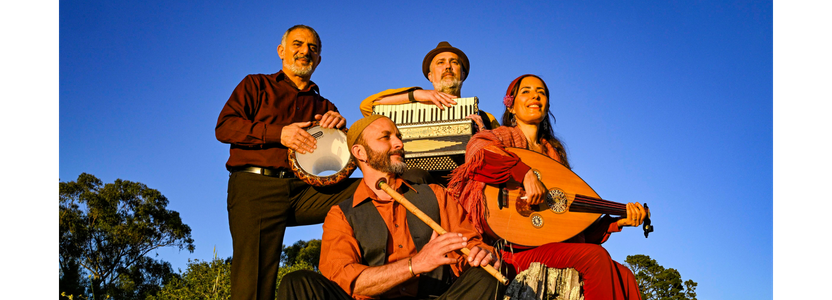
That spirit of exchange is at the heart of The Qadim Ensemble, which I lead with multi-instrumentalist Eliyahu Sills. For more than two decades, we have explored the interconnected musical traditions of the Middle East and Mediterranean, bringing together musicians across cultures and faiths. Our new album, Entre Las Huertas, returns to the Ladino songs carried through generations of Sephardic women — not as artifacts to preserve behind glass, but as a living tradition meant to be played, improvised with and passed forward.
Our ensemble also holds many musicians from different places, religions and cultures, including Israel, Syria, America, with guest members hailing from Iran, Morocco and Palestine; Jewish, Christian, Muslim, Sufi and Druze. Part of our message has always been that music can point the way to a shared humanity and playing and listening together brings people together.
Not Nostalgia — Relevance
This music isn’t really about longing for the past, (though I won’t pretend that longing has no place in who we are). It’s more a conviction that these art forms, born of another time and another way of living, are still relevant now. They don’t just point backward. They point from the past through the present and on into the future — the same chain that started with Solomon.
That’s the thread I keep coming back to: the one running from a king’s poem, through a sailor’s woman in Spain, through a klezmer violinist crossing Europe, through a Yemenite singer in a Tel Aviv club, to me. It is a thread that defines who I am on a deep and inexpressible level. These tunes warm you the way a Shabbat hamin or a pot of sofrito warms you on a Friday night: not an intellectual warmth, nothing to theorize about, just straight to the gut. And they refuse to die because they carry something that never stops being true — the ache of longing, sung in every language that ever tried to hold it. With Entre Las Huertas, we’re simply taking our place in that long chain: tending the music, letting it change us and passing it forward.
The Qadim Ensemble is a San Francisco Bay Area-based global music ensemble dedicated to performing the traditional music of the Middle East with deep authenticity, extraordinary musicianship, and cultural integrity. Led by Eliyahu Sills and Rachel Valfer, the group brings together master musicians devoted to preserving and advancing the living musical traditions of the Eastern Mediterranean. Find out more at https://www.eliyahusills.com/qadim/.
Download The Qadim Ensemble’s new album Entre Las Huertas: https://s.disco.ac/crenjmvlhndi
Stream The Qadim Ensemble’s new album Entre Las Huertas: https://s.disco.ac/tjezzolkjgkc
- Photo by Anthony Pidgeon