
By Guido Chiesa
The film For The Love of A Woman, is drawn from Meir Shalev’s novel, The Loves of Judith, one of the masterpieces of Israeli literature. But one of the most intriguing characters in the film is a creation of screenwriter Nicoletta Micheli to bring the historical novel into today’s world.
The film, opening July 10 at Laemmle theaters in Los Angeles, revolves around a mystery involving two women, bound by an invisible yet unbreakable thread.
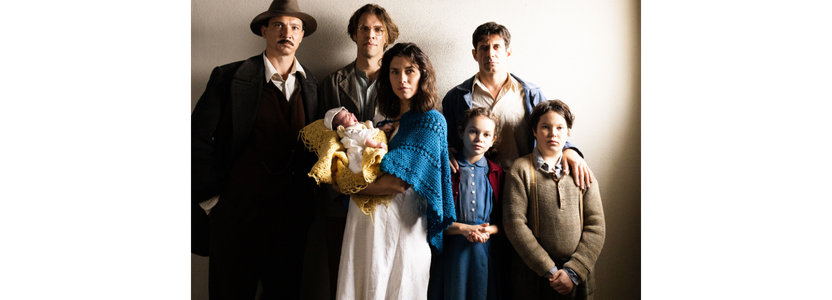
One of them, Yehudit, lived in the 1930s in a rural village during the British Mandate for Palestine, where her arrival sparked a bizarre and tangled love story. The other, Esther, is an American with no real connection to the land of her birth, estranged from her family, and drifting through a life without direction.
Our relationship with Shalev began in 2018 when Maurizio Totti, head of Colorado Film, who had optioned the book years earlier, asked us if we would adapt it for a movie.
Totti had already attempted to make a film out of it in the early 2000s with Oscar-winning director Gabriele Salvatores. Other efforts to adapt it for a screenplay failed.
The problems with an international adaptation of Shalev’s book were numerous: the many characters; the biographical digressions; the quotes and anecdotes deeply rooted in the Torah and the Yiddish tradition. Most of all, the narrative is circular: the reader practically knows what happened from the beginning.
At the beginning of our work we also struggled with the same dynamics.
The invention of Esther and the parallel narration was our key to bring Shalev’s world into our world.
The writing at this point became easier and we had a direction.
In some ways, Esther’s parable was also our perspective as Italians. We are distant from the culture and experience of the young Jews who left Europe to escape persecution and set out to build a new, egalitarian and compassionate society. Yet, despite the historical and cultural distance, we found in their ordeal something that still speaks deeply to us. Mainly because, like all great human adventures, it touches on universal themes. Just like in Shalev’s book.
First of all we decided to give a chronological development to the narration because we wanted the film to offer Shalev’s story a path of resolution and a different view on history and human nature. A problematic and complex view, yet open to hope and change.
Shalev’s novel has a tragic register. Not so much in its tone—full of humour and the breath of great literature—but in its outlook on human events. It describes a closed world, not open to any concrete hope. A world that does not change and cannot change.
This is not only true for the character of Yaakov—tragic par excellence—but of Zayde himself, who is stuck in his past and unable to live, and give life.
At first we thought we were going to develop a reflection on love—the three different ways of loving of Yehudit’s three suitors, Zayde’s shared paternity—and in the end we found ourselves with a story that delves into the theme of truth.
For us it’s the fundamental theme of the film.
To be more specific, how the real truth of any human being is hidden and it is necessary to undertake a painful path to discover it and to be “one with oneself.”
We want the viewer to undertake Esther’s journey in her search for the truth about herself. To go along with her.
Themes like these led us on a journey into the many facets of love, revealing how painful, and yet essential, it is to uncover the truth of one’s own story.
In the end, Esther and Zayde—having retraced the same path of love, death and rebirth as their ancestors—come to understand the importance of engaging with life through empathy, in all its struggles and heartbreak.
This is not a political film, and yet the deeper meaning that runs through it is profoundly political: even in the darkest moments of history, people fall in love, build families, form communities and children are born.
And in this perspective, the lines between past and present and between cultures and peoples, begin to blur, revealing a shared, universal destiny in which it is love that ultimately saves us.
For The Love of A Woman
Opening July 10 at Laemmle theaters in Los Angeles.
Filmmaker Q&As following select screenings
Get Tickets
Guido Chiesa began his career in the 1980s working in the U.S. on films by Jim Jarmusch, Amos Poe and Michael Cimino. His directing credits include Il caso Martello, presented at the Venice Film Festival in 1991; Babylon, shown at the Locarno Film Festival and winner of the FIPRESCI Award at the Torino Film Festival in 1994; Johnny the Partisan (2000) and Working Slowly (Radio Alice) (2004), both in competition at the Venice Film Festival; Quo Vadis, Baby?, the first original series by Sky Italia; I am With You (2010), in competition at the Rome Film Festival; and several successful comedies produced by Colorado Film Production: Daddy’s Boys (2015), Let Me Introduce You to Sofia (2018), and Say it Loud! (2020).
Reboot is the Jewish Outreach and Engagement Partner on For The Love Of A Woman with Panorama Films.