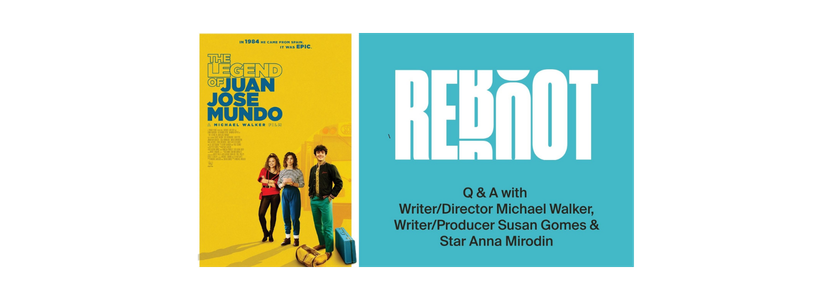
What makes a story Jewish? Is it the characters, the subject, the person telling it, or something harder to define: a sensibility, a joke, a question, a detail that feels unmistakably familiar? The film, The Legend of Juan Jose Mundo, a vibrant coming-of-age story about first love, teenage obsession and identity in 1980s New York, offers an unexpected way into that conversation. Jewishness isn’t always at the center of the frame, but when it surfaces, it reveals something about how culture and identity find their way into the stories we tell. Reboot’s Tanya Schevitz sat down with writer/director Mike Walker, writer/producer Susan Gomes and star Anna Mirodin to talk about the film and the many ways a story can be Jewish without announcing itself as one. Read the interview below or watch the Q&A.
The Legend of Juan Jose Mundo is available to rent on Apple TV and Prime Video now!
The Legend of Juan Jose Mundo is centered on a Jewish teenager, Anna Mirodin’s character of 16-year-old Julie Gornick, whose family is hosting a charismatic and hot Spanish exchange student. A vibrant coming-of-age story, it dives headfirst into first love, teenage obsession, and identity. It’s a deeply relatable look at the chaos, warmth, and nostalgic charm of Jewish teen life in 1980s New York. The film was a standout favorite across Jewish film festivals nationwide, and MiamiArtZine calls the film “Pretty darn irresistible.”
One of the questions we’re always interested in at Reboot is, what makes a story Jewish? Is it the subject, the characters, the person telling it? Or can Jewishness show up in a sensibility? In humor? In the questions an artist asks, or in the little cultural details that find their way into a story?
The Legend of Juan Jose Mundo gives us a really interesting way into that conversation. This isn’t a film that announces itself as a Jewish story, but Jewishness itself does surface in a few brief and pretty memorable moments.
Tanya Schevitz: Mike, Susan, and Anna, thank you so much for joining us. We loved the movie. So many moments resonated with me, in particular. This was literally set in the era of my teenage years, and we have a feeling our audience is really going to connect with it as well. Mike and Susan, what was the first spark for The Legend of Juan Jose Mundo? What made you feel that this was a story that needed to be told?
Michael Walker: Honestly, we were just out to dinner with Susan’s friend Julie, and they started bringing up this guy from high school, Juan Jose and told me the story about how this guy came and hooked up with all the girls in the school, except for her, and she was in love with him, not Susan, the other girl, Julie. And, and I was just like, that would be a great movie.
Susan Gomes: It’s based on my life, me and my best friend. So it was also a best friend story, but also about Juan Jo. He came and in three weeks, he just shook up the entire school. He just came, and he conquered, and that’s what he did.
Tanya Schevitz: And Mike, had you heard these stories before?
Michael Walker: I hadn’t heard this one. I mean, I heard a lot of high school stories before, but this was new, and actually Susan didn’t even remember the story, I don’t think.
Susan Gomes: Well, I remembered him, but I didn’t remember all the details, but yeah, but I remembered him. He’s pretty memorable.
Michael Walker: I thought this would be a great story, and the more I heard about it, the better it was. And it was sort of right after the pandemic, and it gave us an excuse to reach out to a lot of Susan’s friends, so it wasn’t just based on that one true story, it became sort of based on all these stories that we heard from back then. You know, 80s stories, like there’s that scene at the beginning with the, with the Spanish teacher, you know, using some bad Mexican accent to teach Spanish. Somebody told us that. That was just a true story, he said. So, you know, we put a lot of things like that in, and I tried to keep it as true as I could. My experience in high school, I grew up like you in Miami Beach, up until I was 12, in a very sort of similar atmosphere, and then I went to boarding school in England, so I didn’t have much Jewishness in my life.
Susan Gomes: I think when I was growing up in White Plains, New York, I thought, “Oh, I can’t wait to get out of here, this is the worst place,” like every teen feels, and now looking back, I’m like, White Plains was a really pretty idyllic kind of place, especially growing up Jewish. I guess I did not realize at the time that. It was a place where Jews had assimilated pretty early on, like, after they were living, where they were living in the city, they all came to White Plains because they were very welcome. So I just never felt much anti-Semitism. I think growing up in the 70s and 80s also was a really good time, and it was just such a big, diverse school that being Jewish was just a part of who I was, but it didn’t define me, it didn’t make me different, it was a cool place, it was a melting pot.
Tanya Schevitz: Yeah, that comes across in the film. Anna, when you first read the script, what grabbed you? Did you recognize anything in the character, and what did you have to discover in the character?
Anna Mirodin: Yeah, for sure. I mean, the thing that resonated with me the most is she’s a very, I don’t want to say, like, she’s behind, but I feel like she feels not as developed, I guess, for her age as other girls in the term… in terms of being with guys, and just, like, navigating school life, I think she definitely has more youthfulness, which I resonated with a lot, because I think at the time when I read it, I was like, “Oh, she’s very similar to me.” When I auditioned, I was like, I guess I can do, you know, like, my acting stuff that I do for roles, but for her, it felt really easy and natural. But what I discovered about her was just maturity in a different way, and I think she just knows what she wants in life, and I was like, “Oh, maybe that’s me too, like, I don’t have to necessarily do what everyone else is doing, and, like, have a boyfriend by a certain age, or look a certain way, or, you know, do what other girls may be doing at that age, but it’s like, I’m following my own path.
And so I learned that, and also, you know, it being said in the 80s was really cool, because I learned a lot about the 80s and what life was like then. So, like, I honestly want a Walkman right now, like, I just want to, like, get rid of all my gadgets and just, like, buy a flip phone or something.
Tanya Schevitz: I have great memories of my Walkman
Michael Walker: Oh my god. Putting that (the little headphones) on, it was so great. It sounded so good.
Tanya Schevitz: Anna, I love what you said, because it actually feels like that’s much more the generation of today, where they feel empowered. The generation today, I think, feels more empowered to be themselves. Like, our generation, it really was, like, you fit in. Like, you want to try to fit in, or whatever, and you do whatever it takes to fit in, but now I feel like, I mean, I have a 17-year-old I feel like, he’s himself, I mean, he’s popular, whatever, he plays basketball. But he, but he is himself, like, he really is, and I see that among his friends, too, so I think that’s really cool that that resonated with you from the film, because I think that’s happening more today.
Anna Mirodin: Yeah. Great. It is, yeah, for sure.
Michael Walker: Well, people have more access to information now, especially about stuff like, you know, If you were growing up, I guess. You would just look it up on the internet, and who knows what you’d find, but, you know.
Tanya Schevitz: Well, you can find community, you can see you’re not actually that weird, or whatever, because there is so much more out there online. I mean, whatever the problems are of technology, there are also a lot of benefits in that.
Susan Gomes: I was weird, but I didn’t see that. I know, all we got was, like, Seventeen Magazine, Teen Beat, People magazine, which you see in the movie, and that was your information. That was how you had to be.
Tanya Schevitz: Right. Exactly.
Anna Mirodin: I think it’s also, like, making me realize now, too, it’s about kind of taking your own time and, like, being at your own pace with things. I agree with you, I think people in this generation are definitely fighting to have their own identity, but I think there’s still peer pressure, for sure, to fit in and do everything that everyone is doing at this time, because, you know, whatever, like, you see people doing it. So I think also, if I will add one more thing, Julie really took her own time. And, you know, she wants this guy so bad, and she’s trying so hard, but what really stood out to me about her is that she does just take her own time. She’s on her own wavelength.
Tanya Schevitz: Mike and Susan, one of the things that I loved about the film was how it completely transported me back to my teenage years, being a teenager in that era. I mean, I felt like I was reliving my teenage years from, I mean, everything from the clothes, the hair, the exchange students, the parties in the rec rooms, the mixtapes… the mixtapes, oh my god. The letters, the scrapbooks. I still have the letters my friends and I wrote back and forth. And I made out with the exchange student who came to our school!
Michael Walker: Did you? Where was he from?
Tanya Schevitz: He was from Germany. But it was just so funny, I had completely forgotten that, and then this brought that back. So, there are so many details that made that world feel incredibly specific and real. How did you go about recreating that time and that particular teenage experience? Or was it because you got told this story?
Susan Gomes: Well, that scrapbook at the end of the movie is actually Julie’s real scrapbook. So, I mean, we had her scrapbook from Spain, we had, you know, all my friends had photos of the basements, of my house, of Julie’s house. We had everything that really was true at that time.
Michael Walker: Yeah, there’s school jackets from the school that are in the movie. Obviously, we were around in the 80s, but we had to re-remember it, I guess, or, you know, it was asking questions and talking about it, everybody remembered different things. But Julie was definitely a big source of Julie’s journey through the film.
Susan Gomes: Yeah, I like when she told us this story at dinner, I’ll never forget, because it was like she went right back to that time…I don’t want to give too much of the movie away, but when she doesn’t end up kissing him when she has the chance, she was like, I thought my life was over, like, I just wanted to kill myself. And, like, now she’s, you know, in her 50s, but that moment still felt so real for her. When you talk to people about their teenage years, you just feel it and remember certain things so well.
Tanya Schevitz: It made me want to go back and look for my mixtapes. I mean, I’m a hoarder, so I definitely have them somewhere.
Michael Walker: I wish I had mine.
Tanya Schevitz: Anna, you didn’t grow up in that area, and sorry, you didn’t grow up in that era, so what helped you find your way into that world? Were there things about Julie’s teenage experience that still felt completely familiar to you?
Anna Mirodin: Oh, yeah, I think, like, having cliques. I had my own kind of friend group, you know, she has her best friend, and then she has other kids that she talks to, you know, how, like, there’s, like, the athletes, and then the nerds, and the popular kids, I found that to be similar to my experience in high school. I mean, I think the only difference really was just the time, like, how people dressed, how people talked, you know, is all different.
There was a lot of slang that I learned by just, like, reading this script. I was like, “Oh, what does this mean? Like, what does this mean? I just did a lot of research on how people kind of communicated in the 80s, and what was in style at the time, and, like, what music did people listen to, what films were watched, what, you know, what did people like, what were the politics back then, and just essentially what life was like back then. But I found the school experience to be fairly similar to my own, actually. Again, like, she’s not very into, like, big parties, she kind of keeps to herself a little bit. There’s always the mean girl that’s on your ass.
Susan Gomes: When you got your hair in curlers, did you start to feel a little bit different? I heard Margot Robbie once talk about, like, when she did the Wolf of Wall Street, and she got her nails, and they were all long and all of a sudden, this accent just came out.
Anna Mirodin: For sure, I mean, I think the hair definitely played a big part. I mean, it, you know, hair is a big thing. I think it can change a lot about appearance, and it says a lot about just, like, personality, too. What we do with our physical selves, like, our aesthetic, says a lot about, I think, personality for a person. Definitely, yeah, like, having the (permed style) hair was different. Clothes, I think, made the biggest difference, though, for me. I was like, “Oh, I’m wearing this, like it’s so… it’s so 80s.” The shoes, especially. I was like, wow, I’m a whole different person. Yeah, it definitely brings out a character, for sure. Especially because my character would wear a lot of these older, sort of vintage-y… I say vintage now, and they’re vintage now, but back then they weren’t. But, like, these sweaters, and I was like, oh, she’s like a homebody, she likes to be cozy, she’s comfortable, whereas, you know, Suzanne would wear heels and, like, these tight dresses and big earrings and all that, so it definitely informed who Julie was, just through clothing and hair, for sure.
Tanya Schevitz: So I want to talk about Jewishness, precisely because this isn’t an obviously Jewish film. You all come from culturally Jewish backgrounds, but you have very different roles in making the movie. Mike and Susan, I’m wondering, how does being Jewish shape the way you approach storytelling, even when Jewish identity isn’t explicitly the subject?
Michael Walker: It was important for me, just because the characters that it was based on were Jewish, and I, like I said, I grew up in Miami. My memories of movies when I was a kid was that, everybody was Jewish in them, and I was in this, you know, my life was all Jewish people around me, so I just thought that was life, and you know, lately, as time’s gone on, like, through the 90s and 2000s, you’ve just seen that sort of seep out of movies, pretty much, and it’s, you know, it’s become very sort of whitewashed, in a way, at least for me. I mean, in the movies we used to see George Segal and Elliott Gould, and these people, they were the biggest stars of their time, and they were Jewish. They just happened to be Jewish. I didn’t think about it much, but those were the people that were around my house. So, you know, I didn’t want to make a big deal of it, like you say. You know, I put it in just to make sure that it was known. And, and that was really where I left it at.
Susan Gomes: But I just felt it was important to put something out there that was just, you know, Jewish people just living their life, and, you know, it wasn’t the salient feature, it wasn’t anything that was sad, or anything that was, like a painful part of being Jewish. It was just sort of a joyful life that I felt growing up. And I wasn’t actually very religious at all, but I felt very culturally Jewish, and I felt like all the homes, my friends’ homes, they all just had a certain look and a certain feel, and the people that I knew, and I just wanted the movie to have that sort of… just feeling of an identity, but you can’t really put your finger on why, but just feel really comfortable to me.
Tanya Schevitz: So, do you think that making this film changed your ideas about what qualifies as a Jewish story? Does a story actually need Jewish characters or Jewish subject matter to feel Jewish, like, this movie?
Michael Walker: I mean, it’s hard for us, because we went to these Jewish film festivals, and generally they’re pretty full of a lot of heavy Jewish stuff, you know, mostly Holocaust, or October 7, you know, very deep and dark things, and ours is a light high school movie. I think that experience of taking it around there sort of changed what I thought, you know, about Jewishness a little bit. It was culturally Jewish.
Tanya Schevitz: I’m curious how you feel, whether it’s important to tell Jewish stories in this way, not just the heavy, like, in-your-face way?
Susan Gomes: Definitely. I just think it’s more accessible to everybody, then. I just feel like there’s a certain subject matter that a lot of people won’t want to watch, because maybe it’s about October 7th or the Holocaust. But if you can just have it be out there, I think that it would invite more people into this world.
Mike Walker: There are plenty of amazing stories that happen out of the Holocaust, and, you know, and there’s plenty more to be told, but it was a while ago, and there’s things that are happening now. For me, it was an easy thing to take out, but I just wanted… I just wanted to leave it in. So I must have thought it was important in some way.
Susan Gomes: I think it was pretty welcome. We were at Miami Jewish, Toronto Jewish, San Francisco Jewish… but I think it was very welcome. It was a nice break from a lot of the programming, which was nice for us to hear. But then there were also people that were like, why is your film here? It shouldn’t be here.
Tanya Schevitz: Mike and Susan, there are two small moments involving Jewish identity that jumped out of the film. There’s the one at dinner where Julie’s family is hosting him, and Juan says his family knows, or that his father “knows a Jew,” and then immediately says his father’s a banker. And then there’s the sort of quieter moment where Julie comes out, and her mom’s making bacon for Juan, and Julie’s, like, totally surprised. And not just that her mom made it, but that her mom just assumed she didn’t want it. And, so they’re very different moments, but they seem to play with assumptions about Jewish identity, and I was wondering what you were doing there. Was it intentional?
Michael Walker: The bacon was completely accidental, like, I never thought of that as a Jewish thing at all. But you’re not the first person to have said that. I just thought, you know, her mom doesn’t make her breakfast every morning, probably because she’s a girl, but you know, so that was all I thought of for that. I didn’t put two and two together with the bacon, but the first one, yeah, I mean, I was just trying to imagine what it was like in Spain, which was a very different place in 1984, too, and it was coming sort of out of Franco. I did think about him being a banker. It just seemed appropriate for his character to do that. I don’t actually know what Juan Ho’s dad did (in real life).
Tanya Schevitz: It was a funny moment, because you’re just like, “Oh God.”
Michael Walker: It was an awkward moment. But you know, kids didn’t really care back then. They were just surprised, and they’re like, “Oh, okay,” you know, but it’s awkward, because, you know, because it is.
Susan Gomes: I felt like it was more also bringing out some of the cultural Jewishness of it. It’s like, you know, Julie saying, “The last time I saw you drink was at Sammy’s Bar Mitzvah,” and also that, “You know, we’re Democrats.” It had this very sort of Jewish feel to me, how I grew up and what my family was like. So, I think it was just another way to just sort of say, this is who these people are, and this is part of their Jewishness.
Tanya Schevitz: Yeah, terrific. Anna, do you recognize anything from your own Jewish experience in the way you approached the character or responded to the material?
Anna Mirodin: I grew up also culturally Jewish, but not practicing Judaism as a religion, so what you were just talking about, things like bacon and things that you know, if you follow the Jewish tradition and you’re kosher, can’t really eat that stuff, but I had more flexibility growing up, I guess, in that sense.
I never had a traditional Bat Mitzvah, but my cousins have, and like, for my Bat Mitzvah, I remember coming to New York for the first time and, like, watching a Broadway play, so I think it was just, like, the kind of flexibility of life that I would associate with the film?
Susan Gomes: Do you remember what you saw at your Broadway Bat Mitzvah?
Anna Mirodin: Oh yeah, I saw The Phantom of the Opera. It was incredible. Really, really made me want to get into theater and acting.
Tanya Schevitz: So Jewish storytelling often wrestles with memory and belonging, outsiders, the stories the communities tell about themselves. Did any of that resonate with you while you were making the film?
Michael Walker: Yeah, I guess, like, you know, the part that I skipped out in the last question was just that, you know, like I said, I grew up in Miami, in a very Jewish neighborhood, Miami Beach, and then went to England to boarding school, where there were not Jews, and there weren’t Americans, really. And I was, you know, very much an outcast. So, you know, I didn’t really feel Jewish until then.
When we were shooting the movie, we felt very welcome. Jeremy, who runs American High (where it was shot) is very involved in the Jewish community up there in Syracuse, and it was very nice. And we had a lot of people from Syracuse. I wanted to cast as many people as I could who were sort of Jewish, to sort of get the world around them. I don’t know how successful I was.
Susan Gomes: That was important to us in casting, but it wasn’t so easy, actually. We were so thankful to get Anna, who actually was Jewish, because that was important. A lot of the actors actually are. Initially, like, you want everybody to be Jewish who’s part of the friend group, because that’s just who these kids were, but then we realized…
Michael Walker: …We had budget limitations, as much as anything else.
Susan Gomes: We wanted the best actors, also, you know, so that was part of it.I think it was harder, I don’t know, I was thinking about it today, that for me, I think it was harder for Black kids growing up where I was. So, like, the Perry and Amy story, I just think it was easier to be a Jew in White Plains High School, to be a Jewish kid, than it was to be a Black kid, even though it was so diverse there, but I think that’s what was going on more culturally in the 70s and 80s around where I lived.
Tanya Schevitz: Yeah, that was an interesting side story to bring in. It was fascinating. And in that moment in the play when his parents stand up and are just outraged, you know.
Susan Gomes: Unexpected, yeah.
Michael Walker: And that was sort of based on a true story, too. That was another story that we, that Susan remembered. Not quite the play, but they didn’t do the play.
Susan Gomes: It was, it’s definitely a forbidden love. When she went to prom, she had to have, like, a white boy stand in in the photo. She couldn’t have, like, you know, her boyfriend, and there was always a threat you were being sent to Catholic school for certain kids, always.
Tanya Schevitz: And did you remember this story also because of this conversation with your friend Julie, or, like, where did this come out of, or was just your own memories?
Susan Gomes: Just my memory, that always struck me. I’ll never forget that, especially the way the world is today, you know, you can… it feels like you can date whoever you want, and I just always thought that was so sad, like, she couldn’t have her boyfriend. Here he was, he was valedictorian, like, how could anybody’s parents not embrace him? And my mother, I had a single mom, but she was into everything, like, Buddhism and EST (Erhard Seminars Training) and everything that came down the pike, she was into, and so welcoming and accepting, and, like, it just was very surprising to me when I would see that happen. But it was all around. I think my mother was the outlier.
Tanya Schevitz: Anna, tell me more about your Jewish teen years. You said, like, so the Bat Mitzvahs, the Bar Mitzvahs, you had a lot of friends who had these. Did they have the big parties, all that?
Anna Mirodin: My Jewish upbringing would be mostly through holidays, so, like, my grandma would host Hanukkah at her house, or Passover, and Purim and, all these holidays that I would celebrate and learn a little bit about, the Jewish culture and the history of these holidays and why they came to be. I had, like, a pretty diverse group of friends. Some friends were Jewish, and practicing as well. I had a friend who ate only kosher, and he introduced me to kosher pizza for the first time, and I was like, I didn’t even know that existed. So it was just a lot of new things,
Tanya Schevitz: You didn’t have to go to Hebrew school?
Anna Mirodin: No, I did actually. There was one point where I went to Hebrew school because I wanted to learn Hebrew. So I started learning Hebrew for a little bit, and honestly sometimes I feel like I can understand it…definitely more than I can speak it, but I did go to Hebrew school for a little bit when I was around 16 or 17.
Tanya Schevitz: But the Broadway bat mitzvah, that wasn’t your bat mitzvah? That was a friend’s?
Anna Mirodin: That was my bat mitzvah. My mom was like, what do you want to do? And I was like, I’m going to go to New York, because I’m from Canada. And I was like, I want to go to New York and see a play, and she’s like, okay. She got me tickets, we went to see, The Phantom of the Opera, and that was a huge turning point for me just, like, as an actor.
Tanya Schevitz: And I love that. So your mother said, like, what do you want to do? It didn’t have to be this big synagogue production. It was like, your coming of age was this thing that you wanted to do, so it was really sort of reimagined, really. And it sounds like it really was a turning point, like a change in your life. We’re always like, oh, you’re an adult (after the b’nei mitzvah). It actually made a difference.
Anna Mirodin: Yeah.
Susan Gomes: You were in a play in New York, like, last year.
Anna Mirodin: Yeah, The Disappear. It was an off-Broadway play. It played at the Minetta Lane Theatre. It was my first ever professional play that I’ve ever done, and it was off-Broadway, and I was ecstatic. I was like, this isn’t real.
Tanya Schevitz: Is there anything from your upbringing that you recognize in your creative instincts? Like, even if you didn’t recognize it when you were younger, anything from your Jewish upbringing, or family, cultural life that you recognized?
Anna Mirodin: Yeah, oh, for sure. My, so I’m a Russian Jew, so I had a lot of Russian history also in my childhood, and my mom would take me to see a lot of plays, and some would be, like, you know, tailored to Judaism, like, they would be stories about Hanukkah, or, I don’t remember, like, Esther, and just, like, these, people from Jewish history, and then some were from Russian history, and my mom would just take me to see a lot of plays, and I would be… and a lot of movies, like, old movies, Russian movies that I would just grow up with, and a lot of them were musicals, and I think that really fave me that desire to be an actor and to perform. And then my great-grandma spoke Yiddish, and she would sing a lot of Yiddish songs when she was alive, and so I was just always surrounded by music, and culture, too, like, in the Russian sense, and in the Jewish sense as well, and so it just really inspired me to perform and sing, and dance, and be an actor, and want attention from it, too, so… here we are.
Tanya Schevitz: Being Jewish, even though you’re culturally Jewish, were you excited to be invited to play this role of a Jewish teenager?
Anna Mirodin: Oh, yeah. 100%. I mean, this is my first role where I get to play somebody who I identify with as well. Growing up as a Jew, even though I’m not practicing, it’s still a part of who I am, and so it was really cool, like, cool isn’t a great word, but, I was really excited when I saw that, she was Jewish. I was like, oh, like, this is literally me, I’m like, “They wrote this story about me, I just have to play it now.” There’s a lot of things about Judaism that I don’t really know about, because I didn’t grow up in a setting like that where it was practiced, and so whenever I get a chance to play somebody who, whether she’s Jewish, or she’s Russian or, you know, whatever that I’m related to, that I can resonate with, it always makes me want to dive deeper into, you know, my identity part of it, and learn a little more about it, and it inspires me in that sense. So, yeah, I was really excited to play Julie, really honored.
Tanya Schevitz: Oh, that’s terrific that you got this. And you were perfect. You were perfect. So good.
Tanya Schevitz: Mike and Susan, why do you think it resonated with the Jewish audiences? It really has gotten rave reviews at the Jewish film festivals. Like, why do you think that is? Because there isn’t, like we said, so much overt Judaism.
Michael Walker: I don’t want to brag, but, you know, the audiences everywhere like it. I think, especially when it’s surrounded by a lot of misery and strife, that it might come off as sort of easy viewing, but it’s a heartfelt movie. I think there’s a lot of emotion in it, and a lot of memories and it’s very real, you know? And I think that’s what people identify with, I think. It’s culturally Jewish, and I think there’s something very familiar about that. Like I said, I didn’t grow up religious at all, I moved away before bar mitzvahs, but, I still go to a Jewish house, and I feel like I belong there, you know? Like, we were at the Toronto Film Festival, and one of the sponsors had us at their house. It just felt very warm and comfortable, and I think that was part of it. It was a big part of it, I think.
Susan Gomes: I think the parents, too, in the movie, it’s like, the mom to me, she’s so Jewish. I don’t think she’s hamming it up or doing anything, but she’s like, “You’re so cute, I wish you had a boyfriend, you know, I wouldn’t care if he was black.” I don’t know, just her accent, and the way she is, and the dad with the toupee. There’s just something, I think, that feels familiar for Jewish people that may be watching it, that this was how their parents were, or as parents, my mother, who’s 85, I think she just feels like this is how I was, this is how my friends were, how the parents were, and certainly the kids in the movie, I think, I just think it feels familiar and comfortable and nice.
Tanya Schevitz: And I think there are so many people who just identify as cultural Jews these days that they do welcome something like this, where they feel like they are reflected in some way, but it’s not, you know, the whole thing, and it’s not this heavy story. It just gives them something to connect with.
Susan Gomes: It’s interesting, too, like, how many times have we seen this movie while we were editing it, making it, and somebody came to watch one of the screenings that we did, and they were like there’s a menorah behind Julie at the dinner table. And I was like, I never even noticed that. I think a lot of Jewish people always notice that menorah. Now I see it all the time.
Tanya Schevitz: It’s like an Easter egg in there. So someone else put that, the set designer put it in or something?
Susan Gomes: Yeah.
Tanya Schevitz: So just to close here, what, do you hope that audiences take away from this? What is sort of the message? I don’t know if there is a message?
Michael Walker: I don’t think there’s really a message, necessarily, but it’s a journey of Julie going through something that a lot of kids go through, an emotional sort of journey, and finding maybe not to second-guess her, her taste in things, I don’t know, her taste in men. I tried to make the teenage experience as real as I could, as big as I could, because back then those emotions were very strong, and I tried to remember that when I was doing it. We played it very straight and honest like that, and I think that’s missing from a lot of movies these days.
Susan Gomes: Or even just forgiving who you were, things, decisions that you made. Both those girls want the same thing, they want what Amy has. They’re going about it in very different ways, but Suzanne just wants love, and to find a boyfriend, and she doesn’t necessarily do it in the right way, but I can’t judge her. But I think you could a little bit. You shouldn’t, because you shouldn’t. So, I don’t know. And just to enjoy it, really, just to be immersed in that time and place, and have fun.
Tanya Schevitz: Well, I really did. I mean, I was immersed. I’ve been telling all my friends, you have to see this movie. I’m obsessed, I want to watch it again. I felt so good afterward. It reminded me of all my fun times with my friends, and made me reach out to friends.
Susan Gomes: See, that’s, that’s something we would love people to take from it.
Michael Walker: It’s amazing how many, foreign exchange stories we hear at the festivals, too. Like, the first one we went to, there was a woman who came up to us crying, because she met her husband on the Spanish exchange, and she was from Mexico. She was the foreign exchange student, they were married, they were both there. It’s amazing how many of these stories you get.
Tanya Schevitz: Thank you so much for speaking with us, and for putting this out into the world. I think it’s just a joyful representation of life, and of Jewish life, and Jewish storytelling.
*This interview has been edited and condensed for length and clarity.
The Legend of Juan Jose Mundo is available to rent on Prime Video and Apple TV now!
𝘙𝘦𝘣𝘰𝘰𝘵 𝘪𝘴 𝘵𝘩𝘦 𝘑𝘦𝘸𝘪𝘴𝘩 𝘖𝘶𝘵𝘳𝘦𝘢𝘤𝘩 𝘢𝘯𝘥 𝘌𝘯𝘨𝘢𝘨𝘦𝘮𝘦𝘯𝘵 𝘗𝘢𝘳𝘵𝘯𝘦𝘳 𝘧𝘰𝘳 𝘛𝘩𝘦 𝘓𝘦𝘨𝘦𝘯𝘥 𝘰𝘧 𝘑𝘶𝘢𝘯 𝘑𝘰𝘴𝘦 𝘔𝘶𝘯𝘥𝘰 𝘸𝘪𝘵𝘩 𝘰𝘶𝘳 𝘱𝘢𝘳𝘵𝘯𝘦𝘳𝘴 𝘢𝘵 𝘗𝘢𝘯𝘨𝘰 𝘍𝘪𝘭𝘮𝘴.