
Retelling Eden: Feminism, Folklore and Narrative Reclamation


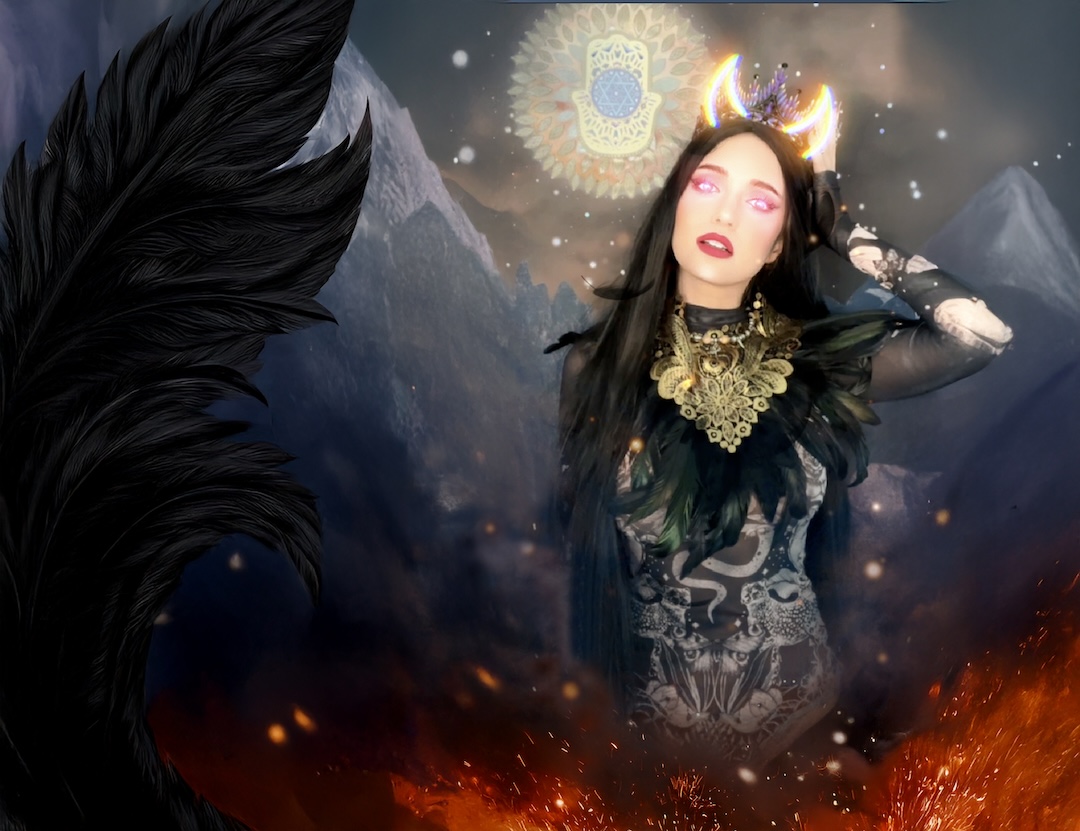
As a formerly Orthodox, now secular, deeply online millennial woman who loves the incredible extended chain of shared imagination that makes up the Jewish people’s collective narrative world-building, Miriam Anzovin refused to accept the interpretations of Tanach, Talmud, midrash and folklore that she was handed as a final draft. After all, Jewish texts are multivocal – there is rarely is a “final word.” Her “Jewish Lore Reactions” project, an ongoing short-form digital video series in which she remixes and retells epic stories about iconic figures from Jewish lore, began as a response to what she learned – part delight, part frustration, part existential scream – and a desire to give a voice to female characters who have been marginalized, flattened, or weaponized by a tradition shaped largely by male storytellers.
By Miriam Anzovin
Jewish tradition is an extraordinary, centuries-long act of collaborative imagination. Tanach, Talmud, midrash, folklore, music, and poetry form an evolving narrative ecosystem, one shaped by exile, resilience, argument and creativity across time and place. I’m fascinated by it and I wanted to explore that inheritance not as a museum piece, but as a living canon: messy, funny, unfinished and still arguing with itself.
But here’s the plot twist.
I’m not here to retell only the “greatest hits” of Jewish lore. No disrespect to the Golem of Prague, of course. He can relax. I will get to him eventually. What draws me instead is the work of discovering and centering female characters and voices, and offering commentary on their stories, sometimes comedic, sometimes heartfelt and often both.
Because these figures emerge from a deeply patriarchal tradition, shaped over centuries by male storytellers who didn’t always bother to give women names, this work can be a challenge.
And I’ll take that challenge!!
In the words of Rabbi Lady Gaga, let me t-t take you to the Garden of Eden for a case study on adapting ancient texts into modern context.
My methodology begins with a first encounter with a text, a character, or scene and my immediate reaction to it. The guiding principle of the series is that every plot twist and character trait must be rooted in at least one classical source. I pay close attention to my physical responses: Am I grinning, entertained? Am I nodding along, recognizing a deep truth that resonates with me? Or am I experiencing an overwhelming need to scream into the void I’ve had conveniently installed in my closet for just these occasions?
The Women of Gan Eden
I set out to tell the story of the three women of Gan Eden (yes, three), and their collective trash husband, in a four-episode mini-arc.
So in the beginning, I encountered Chava Rishona, AKA “The First Eve,” in the pages of Howard Schwartz’s encyclopedia of Jewish mythology, The Tree of Souls. She was Adam’s first companion in the Garden of Eden, and thus, the first woman in Jewish lore. I delved further. From Bereshit Rabbah, I learned God created her Westworld-style: skeleton, organs, connective tissue fully on display…all while Adam is watching this all go down, seeing “her full of viscera and blood,” getting the ick. Unable to cope with a partner who hasn’t been sanitized for the male gaze, he asks God to scrap her and try again for that perfect hot tradwife, will “one who would excite me the entire night, by inducing in me erotic thoughts.”
Yikes, what a staggering amount of chutzpah, coming from a man literally made of dirt. Immediately, I recognized Adam’s red flags as a toxic manosphere misogynist, whose “your body, my choice” approach dooms Chava. The first woman to be told she is simultaneously not enough and too much, all on the very first day of her existence.
Chava Rishona has no dialogue in the text. But if anyone deserves a speech, it’s her. So in my retelling, Chava gets her own variant of the Barbie monologue. Who better to critique the male discomfort with women’s bodies than the first maligned female body itself?
The next episode, “The Night Queen” introduces the most famous (certainly, the most notorious) woman in Jewish lore: Lilith.
In the Alphabet of Ben Sira, the primary written source for Lilith’s story, Adam thinks Lilith is hot enough, and he hasn’t seen her face with no skin on it so that’s great for him. But he’s also the first overconfident, delusional edgelord who declares that he is superior to her. He demands Lilith obey him in all things, especially sexually: “I will not lie below, but above, since you are fit for being below and I for being above.”
Lilith shuts him down, reminding him he’s “made from the earth.”
Then, rather than hard-launching the relationship, Lilith hard-launches herself into the air by invoking the Divine Name and flying out of Eden. Who among us would not use an incantation to dip from a bad date, I ask, whomst?? (Adam, desiring himpathy, kvetches to God: “Master of the Universe, the woman you gave me fled from me!” The original “the breakup came out of nowhere!”)
When Lilith has a dramatic, airborne showdown with three bounty-hunter angels (Sanoy, Sansenoy, and Samangelof) sent to drag her back to Eden, the text reveals something devastating: Lilith understands that God created her to function as a villain in the story. And she chooses that role.
She also chooses what comes with it. A punishment of pure body horror: that “a hundred of her children will die every day” rather than return to Adam.
Despite later folklore recasting Lilith as a vampire-coded baby-killer and seducer of human men, in the Alphabet of Ben Sira she does something that doesn’t match that depiction: she tells her three angelic ops exactly how human beings can protect themselves from her, detailing the use of amulets to remain “marked safe.”
This was striking to me. Would a true villain, the biggest “big bad” in all of Jewish lore, really do that? No way in gehennom! I read Lilith in the text not as a villain. Rather, she is a woman who knows exactly who she is, what she wants, and what she refuses. A vastly misunderstood proto-feminist icon.
Of all three women, Lilith was perhaps the easiest character to adapt. Her story is about radical bodily autonomy vs. patriarchal subjugation and forced birth. There could not be a more timely story than hers to retell in this modern American era. I immediately thought of the immortal line from Jane Eyre, and gave it to Lilith: “I am a free being, with an independent will!”
The final two-part episode, “Trouble in Paradise,” part I and part II focuses on the better-known Chava, Eve 2.0. This is Eve from the story of the snake (OG pyramid schemer), the fruit of the Tree of Knowledge of Good and Evil (aka the first nootropic), and the eviction from Eden. The sources here give so much detail to work with: God being the entire glam team for Eve’s bridal look (referenced multiple times in the Talmud), the snake’s animosity toward Adam (Pirkei DeRabbi Eliezer), and it’s deeply unsettling sexually predatory behavior toward Eve, “lusting after her” (Bereshit Rabbah). Even paradise, it turns out, was not a safe space.
Adapting Eve’s story was complex. Her consumption of the fruit from the Tree of Knowledge of Good and Evil has been weaponized against real women for millennia. Eve becomes the fall gal (literally), for all worldly problems, and the example used by the patriarchy to help keep women subjugated to men. Of course, this conveniently ignores Adam’s participation in being metaphorically redpilled by the tree.
But as I read her in the texts, Eve is the first woman in STEM, willing to research the unknown, to seek knowledge of God’s creation. Hence her reason for eating the fruit of the Tree of Knowledge, because it’s “medicine for the enlightenment of the eyes… by means of which to understand” (Targum Jonathan on Genesis).
Delving into Pirkei DeRabbi Eliezer and Targum Jonathan offered me an unexpected gift: Eve “saw the Angel of Death” at the Tree of Knowledge. The Angel of Death is one of my favorite Lore characters, and now I could put Death in dialogue with Life (the translation of “Chava.”) A cameo made possible because it already existed in the texts – no baseless fan-fiction encounter invented here! (Well, none invented by me at least. Midrash is, at heart, rabbinic fan-fiction. The AO3 of antiquity.)
The arc culminates in God’s judgment and punishment of Adam, Eve, and the snake, adapted from the Genesis, multiple midrashic sources, and feminist commentary. Eve gets her day in court, speaking out against her sexual harassment by one male (the snake) and betrayal by another (her own husband, who threw her under the bus in a plea deal attempt.) Translating Eve’s testimony into Taylor Swift and Cardi B lyrics was the obvious way to go.
Each video includes a detailed source list. After all, my role as a reteller of Jewish stories is not only to share what I have learned through short, fun, dynamic videos, but also to invite viewers to feel empowered to engage with the source material themselves, on their own terms. Think of it as a gateway (drug) into deeper Jewish literacy for those encountering these stories for the first time.
Because these are not my stories. They are ours. An extraordinary creative heritage that belongs to the Jewish people as a whole, to be told and retold in fresh and evolving ways in every generation.
My way just happens to involve strategic emoji usage.
Related