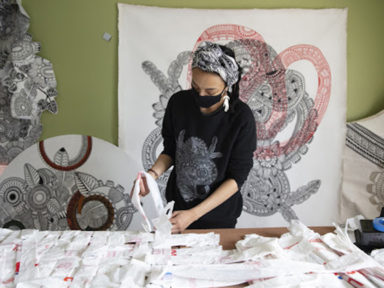

“70 Seeds” is a group exhibition imagining vibrant, pluralistic futures of American Jewish life––two thousand years after the fall of the Second Temple. Produced by Becca Leviss of the Judeofuturism Project and curated by Aimee Rubensteen of MyFi Studio, the exhibition brings together 11 American Jewish artists drawing on their own questions and hopes of Jewish futures alongside speculative art, strategic foresight frameworks, and Jewish rituals and texts; the artists work in soft, gathered, and digitized materials, performance and interactive installation, to imagine textures of Jewish community, ritual, identity, diaspora, and belonging. The 70 Seeds exhibition will be on view in Boston October 27 – November 8, 2026 with public programming, including artist talks, tours, facilitated community workshops, Shabbat services and innovative ritual experiences. The exhibition can also be viewed online. Leviss shared the genesis of the project with Reboot.
By Becca Leviss
All my life, I have been a worrier. Growing up, my nightly prayers felt less like a moving rendition of the Shema and more like a laundry list of everyone and everything I cared about and every possible tragedy that could befall them. I worried about my parents and grandparents’ health, my sister’s test grades, my test grades, tennis matches, if I would ever become a famous actress (ha!), how many kids I would have, would I even have kids at all, and precisely at what age and under what conditions I would eventually die. Every detail was agonized over. I’m under no illusions that this makes me at all special. A controlling, ambitious, anxiety-ridden Jew? Groundbreaking.
What might make this all a bit ironic, however, is that now this controlling, ambitious, anxiety-ridden Jew is trying to help our communities imagine the future not clouded with fear and grief, but oriented towards vibrant pluralism and collective thriving. The shoemaker’s children have no shoes, and so on.
In many ways, I didn’t exactly plan for this. I started exploring futures work in late spring 2023 when helping launch Democracy 2076, a nonprofit providing strategies to inspire renewed faith in pro-democratic, protopian futures that moves people to action in service of a resilient democracy. I saw the ways that short-term thinking kept diverse stakeholders isolated from each other, and how authoritarianism weaponized fear and violence to keep us unable to imagine a world any different from how it is right now––and in doing so, limited our toolkits and capacities to actually usher that different world into existence.
In September 2023, I began my studies at Harvard Divinity School, excited to explore the ways in which faith and ethics shape how we build and participate in our political and communal infrastructures. I dove headfirst into frameworks of Afrofuturism and Afropessimism, W.E.B. Du Bois, and James Baldwin. I was inspired by these frameworks of meaning-making, power-generating, and radical imagining amidst centuries of extreme violence and dehumanization.
Then, that fall, the ground gave way under almost everything I’d been studying. And so I went looking for how my own tradition has kept imagining and building through catastrophe.
The Gemara tells a story about Honi HaMe’aggel, Honi the Circlemaker, who is walking down the road one day when he sees a man planting a carob tree. Honi is perplexed by this man planting trees that will not bear fruit for another seventy years––fruit that this man will likely never see. Honi exclaims, “Is it obvious to you that you will live seventy years, that you expect to benefit from this tree?” The man responds that he himself was born to a world full of carob trees: “Just as my ancestors planted for me, I too am planting for my descendants.” (Taanit 23a:15)
In classic Talmud fashion, Honi then mysteriously falls asleep for seventy years, during which a cliff forms around him and hides him from view. When he awakes, he encounters a different man gathering carobs from that same tree, which is now fully grown and bearing fruit. Honi asks if this man is the same one who planted the tree. The man responds that he is the grandson, harvesting the fruit from the tree his grandfather planted a lifetime earlier. (Taanit 23a:16)
There is a famous Yiddish expression: “Mann tracht un Gott lacht.” Man plans, God laughs. But so, too, it is with planting. Planting asks for a particular kind of humility. You put a seed in the ground without knowing whether it will take, what the weather will bring, or who will be around to reap the riches of the harvest. And yet, we have a sacred obligation to plant nonetheless––not despite the uncertainty and unknowing, but because of them.
In moments of crisis and crash within Judaism, different worlds were imagined, and different seeds were planted and nourished without a guarantee of what they would grow into––or whether the planters would even be around to see their fruition. As the Second Temple burned, Rabbi Yochanan ben Zakkai pleaded for the sparing of the city of Yavneh and her sages. After persecution and expulsion from Spain, the mystics of Safed imagined a shattered world that human hands could help repair. In Altneuland, amidst the violence of post-Emancipation Europe, Herzl imagined a utopic Jewish state. And right now, in living rooms and classrooms and congregations, people are planting exciting and imaginative seeds that are just starting to grow.
In this compounding moment of chaos and churn––call it polycrisis, birth pangs, death knells, or something else entirely––it is all too easy to let fear and grief become paving stones of the refrain, “things will always be this way.” And yet, I have seen so much hunger in the workshops and classes I teach, the organizations and congregations I’ve had the privilege of working with—we want different stories. Stories rooted in joy, creativity, resilience, and collective flourishing. I believe in the ancestral intelligences (to borrow a phrase from the Jewish Afrofuturist Lonny Avi Brooks) of Jewish communities to envision and tell them.
70 Seeds is an attempt to share some of these stories with all of you––to create a container both in-person and virtually for artists and creatives to share their visions of futures of American Jewish life in 2070. It takes its name, in part, from a long horizon: two thousand years after the fall of the Second Temple, and roughly half of a lifetime from now. It also is inspired by the ways in which this exhibition holds far more questions than answers––and that the full impact of what we are imagining will arrive long after we expect it.
The exhibition invites us to wrestle with some big ideas. What does it mean to be American, Jewish, and an artist––now and in 2070? What gets handed down: the customs, materials, and stories that pass quietly between ancestors and descendants? And what will the ritual objects and ephemera of Jewish communities yet to come look like, the things someone in 2070 will reach for for grounding and connection?
None of these works claims to be the Jewish future. That’s precisely the point. Each is one seed: a possibility made concrete enough to examine, walk around, argue with, and come back from a little changed. Some will move you. Some will inspire you to imagine futures of your own. Some might annoy or frustrate you. (And that’s ok! Productive annoyance feels like a sacred Jewish tradition.)
70 Seeds doesn’t end when the show closes. Alongside the exhibition, we’ve created a digital exhibition and facilitation guides for clergy, educators, and community leaders, so anyone can bring this practice home. We’re also teaching a six-week course with Judaism Unbound’s UnYeshiva in which we will use the ideas embedded in these artistic works as starting points for our own questions and ideas of futures of American Jewish life.
Find out more about the exhibit and how to see it online.
Reboot is a co-sponsor of the program and Reboot Network member Olivia Guterson is a featured artist with hand-sewn prayer books that consider what we inherit, preserve and remake for generations to come. Guterson will lead a closing workshop on November 7 as part of the exhibition’s public programming.