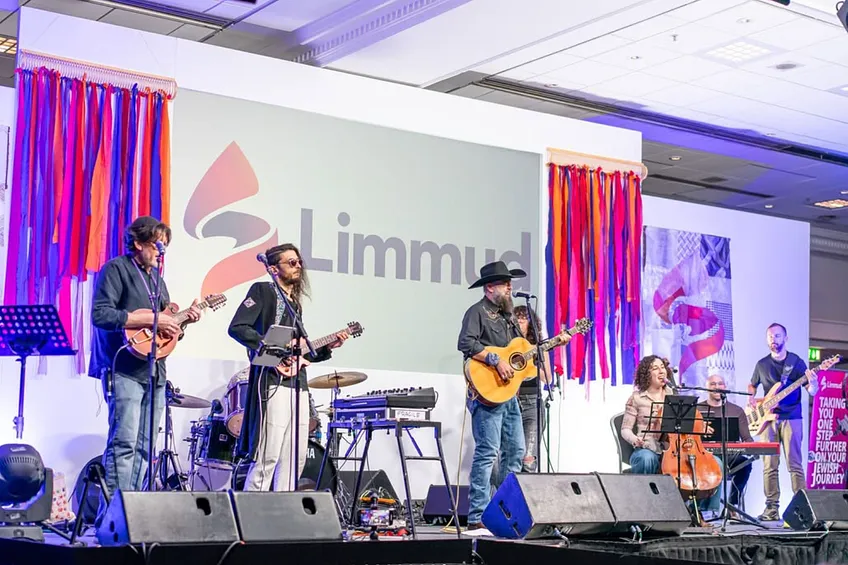
On Christmas Day, I boarded a plane from Los Angeles, California to Birmingham, England, and wandered into a parallel Jewish universe called Limmud. In this place, there was, remarkably, no Chinese food to be had.

For the uninitiated, the best shorthand I’ve found to describe Limmud is a cross between Jewish Comic Con (minus the cosplay), Edinburgh Fringe, and Glastonbury. It is a festival of learning, culture, performance, argument, prayer, food, laughter, discomfort, curiosity, and the occasional escape room about intergenerational Jewish mother trauma that involves pickles. So yes, even in a Jewish safe space, a few familiar tropes still wander through the lobby, only to be taken apart later over the mid-afternoon coffee break.
Limmud’s own framing is beautifully straightforward.
Their vision: an uplifting and dynamic Jewish world powered by vibrant and accessible learning, bold and inclusive leadership, and deep relationships that transcend our differences.
Their mission: to inspire and empower people to learn, lead, and build community, catalyzing change that revitalizes Jewish life in the UK.
Their promise: wherever you find yourself, Limmud will take you one step further on your Jewish journey.

I went because I was invited to teach. I stayed because I saw a living answer to a question that has been sitting in my chest for a while: what does Jewish cultural life look like when it refuses to flatten itself?
The program alone reads like a manifesto. Take a snapshot from a single day and here’s some of what you get —
In one corridor, you can walk into a session on Jewish social entrepreneurship and global changemaking. Two rooms later: “Is G-d a sandwich?” Down the hall, a humanistic, nontheistic Kabbalat Shabbat service for the curious, the agnostic, and the “Spinozist.” Later that night, a tisch of niggunim traveling from Baltimore to Iraq. The next morning, mindfulness rooted in Shabbat. The next afternoon, a serious conversation about sexual abuse in insular communities and the risks of “cultural sensitivity.” That evening, a lecture on Emma Lazarus and American immigration ethics, followed by Jewish funk and Vulfpeck, and then a workshop on having productive arguments about Israel. This is just a small sampling of the daily programming, all of it dense, unruly, and resistant to simplification.
This is what I mean by unflattened.
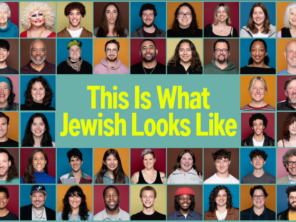
Not consensus. Not branding. Not “one Judaism to rule them all.” Instead, a messy, polyphonic ecosystem where the Jewish story is not a single genre and Jewish identity is not a single face.
I led four sessions at Limmud, spanning the future of Jewish storytelling, comedy and Holocaust memory, intersectionality in the Diaspora, and the recovery of hidden Jewish histories through film.
I came to share the work we do at Reboot Studios: developing and funding film, television, digital, and audio projects that explore Jewish identity and spark dialogue. I expected good conversations. I did not expect the volume and intensity of what happened afterward, especially following Jewish +, a talk about underrepresented Jewish identities and the way film and media have historically narrowed the Jewish frame.

People kept coming up to me with variations of the same message.
Thank you for not making Jewish storytelling only about the Holocaust.
Thank you for not treating Ashkenazi as the default setting.
Thank you for making room for Sephardi and Mizrahi stories, for queer Jewish stories, for Jews who speak Arabic or Farsi or Ladino at home, for Jews whose Jewishness is lived through culture as much as through synagogue, for Jews who do not fit neatly into anyone’s drop-down menu.
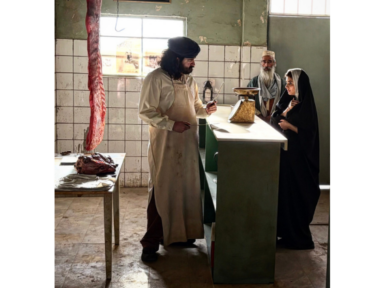
In those conversations, I also felt the carefulness, even the fatigue, around certain language. “Jews of Color” can be a useful umbrella in some contexts, and in others it can feel like it turns real communities into a category. Limmud reminded me that diaspora Jewishness is not a single axis. It is history, geography, class, politics, faith, trauma, joy, and lineage. It is also the stubborn fact that Jews have played meaningful roles in countless countries beyond Israel and the United States, often in ways that do not map cleanly onto the stories we have grown accustomed to seeing on screen.
Leaving those sessions, I kept thinking: there is an audience for complexity. Not a niche audience. A human one.
Which is why, a few days later, an essay in The New York Times by Reboot Network member Mireille Silcoff landed with such force.
Silcoff wrote about something many of us have felt but struggled to name: a pattern of films about Jewish cultural figures that barely mention their Jewishness.
Her entry point is personal. She is grieving her father, listening to Neil Diamond, and eager to watch Song Sung Blue, a new film that builds an emotional world around Diamond’s music. The film is, by her account, moving and well made. It is full of Americans of many backgrounds who love Diamond.

And yet there are no Jews in it. Not really. Not even a hint of the thing that made Diamond “Diamond” for her father, and for so many Jews of that era: the feeling of an immigrant-rooted Jewish introvert stepping onto an American extrovert’s stage, carrying generations of fear, striving, and audacity in his voice.
“The stories are about us,” she writes, “but we’re not in them.”
That line stuck with me because it points to a paradox that goes well beyond one movie.
On the one hand, Jews have long fought for belonging in mainstream culture. Success, assimilation, and acceptance can look like a story in which Jewishness becomes unremarkable, blending seamlessly into the broader American one.
On the other hand, when Jewishness is not simply blended but actively removed, when it becomes cosmetic or silent, you end up with something stranger than assimilation. You end up with erasure. A story that is Jewish in its DNA but scrubbed of Jewish interiority.
In 2026, with Jewish identity simultaneously hypervisible as a political object and carefully managed as a cultural one, that tension feels especially charged.
Here is the trap: the same universality that can open doors can also hollow stories out.
When “universal” becomes code for “less Jewish,” the result is not a bigger tent. It is a smaller truth.
Silcoff’s argument is not that every film needs a didactic seminar on Jewish history. It’s that particularity is often what makes art resonate. Neil Diamond’s universality is not despite his Jewishness. It is, in large part, because of it. The specificity is the engine.
This is where the conversation gets thornier, because the problem is not only omission. It is also distortion.
There is a growing public debate about how Jews show up on screen when Jewishness is present but untethered from lived context. Sometimes Jewish identity becomes a prop. Sometimes it becomes shorthand. Sometimes it leans into caricature. Sometimes it gets used as a permission slip for humor that is not actually doing the work of memory or empathy.
So the question is not just “Where are the Jews?” It is “What kind of Jewishness are we allowing, and what kind are we sanding down?”
If the only acceptable Jewishness is the version that is either invisible or easily digested, then we do not actually have representation. We have a controlled image.
This is why Limmud matters.
Limmud is not a film studio. It is not a commissioning body. It is not a distribution platform. It does not exist to decide which stories get made or which voices get amplified. Instead, it functions as something more elemental: proof that Jewish life can hold multitudes without collapsing.
It is a space where people can study sacred texts and interrogate them, sing ancient melodies and remix them, wrestle openly with politics and theology and ethics, and explore sexuality, trauma, and joy without pretending there is one correct Jewish way to be a person.
In other words, it is an antidote to flattening.
And it made the stakes of Silcoff’s point feel sharper. I had just spent a week inside a Jewish world that was wildly textured. Then I returned to a media landscape where Jewish stories are too often made palatable by being made less Jewish.
That gap is not inevitable. It is a set of choices.
At Reboot Studios, our job is not simply to increase the number of Jewish stories. It is to expand what Jewish stories are allowed to be.
Not only Holocaust narratives. Not only Ashkenazi narratives. Not only stories where Jewishness is a flavoring or a punchline. Not only stories where Jewishness gets softened so everyone can relate.
We are interested in the opposite.
Jewish stories that lean into Jewishness.
Jewish stories that are specific about place, language, and lineage.
Jewish stories that acknowledge pain without being imprisoned by it.
Jewish stories that reflect the diaspora as more than a footnote.
Jewish stories that make room for contradiction, humor, anger, tenderness, and moral complexity.
Because in a moment when so many cultural forces reward simplification, I spent a week among several hundred Jews who were asking for more nuance, not less. More texture, not less. More specificity, not less.
And that is the audience I want to serve in 2026 and beyond.
Not the imaginary “universal viewer” who can only handle Jewishness in a diluted form, but the very real human beings who recognize that the universal is often born from the particular, and that the most generous stories are the ones brave enough to tell the truth about where they come from.
Read more from Noam Dromi on his Substack.