
Finding Bashert in Grief


Bashert is by far my favorite Yiddish word. To translate bashert just as “meant to be” doesn’t do it justice. Bashert has a touch of mystery to it. It’s the feeling that invisible threads are quietly pulling your life in kismet directions (It’s ok to use a delightful Turkish word to describe a Yiddish word, right?) What the millennials have freshly discovered as woo-woo. It’s ok: I’m an elder millennial. I can poke fun at my own people.
I’ve done my best Linda Richman impression and declared “Absolutely bashert!” after finding my calling as a designer and musician, finding my soulmate, and, most recently, starting a business.
Those familiar with Yiddish deep cuts might call me a shvitzer when I brag about my dad. It doesn’t take much to get me started. My dad fathered three daughters as well as a totally new federal government discipline called Technology Transfer. He designed a coffee table out of a tree trunk as well as the cockpit controls for the stealth fighter jet. He wrote short stories as well as a parody song that is in the Congressional Record. He once volunteered to be an extra in Trading Places as well as a centrifuge stand-in (strap-in?) for John Glenn. He fought for civil rights, championed prostate cancer awareness, and rescued injured seabirds in his Prius. He was curious, funny, and ended every voicemail with “Love ya, hon.”
I lost him to dementia during the pandemic.
Like many who lost during that bleak time, I felt I missed the opportunity to grieve with community. But if I’m honest, some of what I lost came from choices I made myself.
My father died during my only week off between jobs. Just days earlier, after a year of failed IVF, I’d discovered I was spontaneously pregnant with my second child. I watched his snowy Pittsburgh funeral on Zoom, organized an afternoon virtual shiva from afar, and then the next morning, logged onto Zoom again for my first day at a new job. I didn’t tell my new boss what had happened until months later.
Any therapist worth their sofa would remind me there’s no wrong way to grieve. I believe that. I’m also first to admit my decisions in those first days weren’t my finest work. My grief has been leaking out fakakta ever since.
Earlier this month I attended a virtual Death over Dinner gathering hosted by Shomer Collective. I can’t tell you what anyone else shared, but I can tell you that I gave myself a failing grade for holding it together. I unexpectedly found myself sobbing into my webcam in front of a breakout room full of strangers. I’m embarrassed that four years in, my grief still sits so close to the surface.
That conversation reminded me that Judaism has spent thousands of years refining something many of us try to improvise: how to mourn. Or, if you’ll indulge my inner theater kid: Tradition! (Please hear that in Tevye’s voice.)
Shiva interrupts ordinary life for seven days. Yizkor invites us into communal remembrance four times a year. These rituals exist not because grief follows a schedule, but because grief needs a container sturdy enough to hold emotions that otherwise seep into daily life’s cracks.
There was one ritual I never struggled to embrace: the annual lighting of a yahrzeit candle. Maybe it’s because there’s no script to memorize for the “I was told there’d be no Hebrew!” crowd. It was one of the few Jewish traditions where I never worried I was doing it wrong.
Then one day, fellow designer and JCC preschool mom Ruth Siegel said to me, “You know what I wish we had better options for? The yahrzeit candle.”
I laughed because I’d secretly wondered the same thing for years. Why do the only options on the market look like the people packaging gefilte fish accidentally stumbled into the candle business? That conversation turned out to be bashert.
Maybe it’s my elder millennial wiring, but I love looking at something that’s always been done one way and asking, “Ummm, but must we?” I know my generation doesn’t own that instinct, but is it just me or are millennials extra loud, proud and willing to crack open taboo clouds? Mental health. Fertility. Neurodiversity. Burnout. And, perhaps most quietly of all, grief.
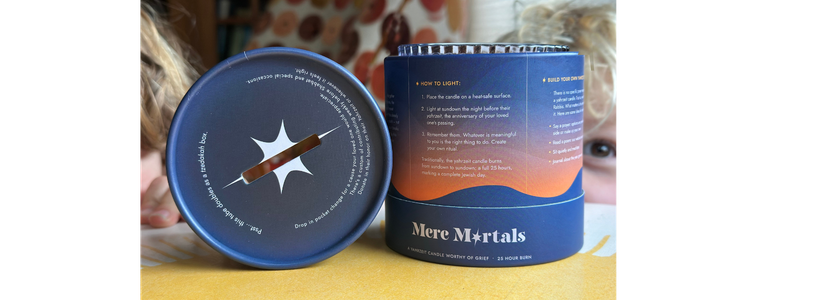
So when Ruth and I looked at the humble yahrzeit candle, we weren’t trying to disrupt an ancient ritual. We were asking a designerly question: “How might we reimagine this ritual object to better serve people and our planet?”
What began as a bond over being unwilling members of the Dead Dads Club became something much deeper. We thought we were redesigning a candle. In reality, we were designing permission: permission to pause, permission to remember, and (if I could speak to my former self) permission to tell a future employer, “I can’t start Monday. My dad just died.”
Ruth and I have turned our project into a Kickstarter campaign called Mere Mortals that just last week reached its funding goal. Last week Mere Mortals also co-hosted a virtual panel with Reboot and Shomer Collective about creating personal remembrance rituals (don’t worry, we recorded it!). That conversation reminded me that I actually can’t give myself a failing grade for how I’ve tended my garden of grief despite the cracks. I’ve been cultivating a budding ritual that I want to regale you with in hopes that it inspires you too.
During the pandemic, I found myself living in an unlikely place: Filoli, a historic garden estate where my partner’s work gave our family employee housing. I wandered the grounds so often that I developed a completely serious Top Ten Trees Tour, which I insisted on giving to anyone who came to traipse with me. On one Father’s Day, I even FaceTimed my dad and walked him through the whole leafy ranking as though he were watching US Open highlights.
After my dad passed, my splendid friend Sadia, also an unfortunate member of The Dead Dads Club came to visit and the tour took on new meaning.
Filoli is filled with redwoods that grow in circles. After an ancient tree falls, offspring trees grow from its roots. They’re called fairy rings. In my newborn haze, I pet-named them Mother Rings. Sadia saw all that grandeur, but then we took a long walk through a large open field to the estate’s only solo redwood towering in an open meadow, impossibly tall and untouched.
As we walked, we talked about our dads, our memories, and the strange ways grief evolves. We decided this tree would be The Father Tree. Along the path she found a discarded three-point buck antler, which she still kept on display even through multiple moves.
Sadia reminded me of our walk after the rituals panel. It made me realize that rituals don’t have to be ancient to be sacred. Sometimes rituals are as simple as revisiting the same tree with the same friend and giving memory a place to live outside your own mind.
For years I reserved bashert for galactic moments like finding my person or my path. Mere Mortals has taught me so much about processing my own grief as well as teaching me that by creating something we need, we might become part of someone else’s bashert.
This Father’s Day, I’ll call Sadia. If I can’t reach her, I’ll sing her a voice memo retelling the story of the Father Tree and ask her when we’re going back. The redwood will still be there. The antler is still on her shelf. I’ll definitely end with “Love ya hon!” Can that be what bashert means too? Two friends choosing, again and again, to keep showing up for each other and their people whose memories are blessings.
Check out the last few days of the Kickstarter campaign to snag your own Mere Mortals candle.
Rebecca Garza-Bortman is a designer, musician, and ideation facilitator. She was an early designer at YouTube, founding designer of MasterClass, and now leads Co-building and Collaboration at Learning Commons. She’s fronted the bands My First Earthquake, Happy Fangs, and now Love Jerks with her rockstar husband. They are raising two children to be feral and exuberant like their parents.
Related