
Passover has always been a time to gather, to retell the story of exodus, and to ask: What makes this night different from all other nights?
But last year, my own seder cracked wide open. What was meant to be a night of ritual and remembrance erupted into grief, anger, and division. Friends within my own community clashed over what was happening in Israel and Palestine, over what it now meant to feel safe as a Jew in the world. What was once a table of shared ritual had become a site of rupture.
I left that night shaken—not just by the arguments, but by the deeper fracture it revealed. A fracture that so many of us are carrying. A fracture that isn’t just political but personal, spiritual, generational. A fracture that is both ancient and entirely of this moment.
That night, I knew: this is where art must begin.
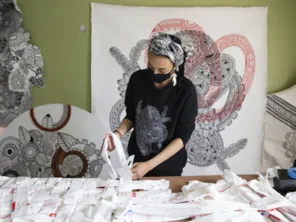
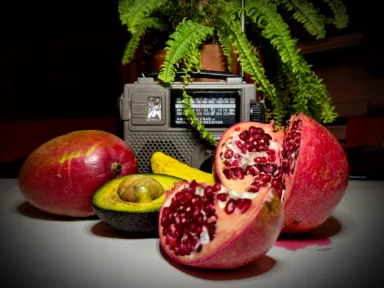
From that rupture, The Broken Seder was born. This installation, presented at the Jewish Community Center of San Francisco (JCCSF) from April 3–6, reimagines the seder table as a meditation on brokenness and wholeness. Through visceral, symbolic tablescapes, it explores the raw emotional terrain of Jewish life today: exposed, hardened, hopeful, protective, alarmed, rooted, resilient.
The seder plate is one of the oldest ritual objects in Jewish life—a container of memory, suffering, resilience, and liberation. But what happens when the plate itself is fractured? What happens when the table is split in two?
This installation does not offer answers. It is not a neat resolution, not a place to be comforted. Instead, it is a space to sit with what is unholdable. To look directly at what has broken. And to ask: What now?
Why Art? Why Ritual? Why Now?
We are living in an era where meaning is flattened, where conversations collapse before they begin, where nuance is the first casualty of urgency. But art resists that flattening. Ritual resists that collapse. They demand something from us. They slow us down, stretch us open, and refuse to be distilled into a single takeaway.
Leonard Bernstein once said, “A work of art does not answer questions, it provokes them; and its essential meaning is in the tension between the contradictory answers.” This is why art matters in times like these. Not to soothe, but to disturb. Not to simplify, but to expand.
Artists are not meant to stand at a safe distance from the world’s fractures. We are meant to step inside them, to gather the broken pieces, and hold them up to the light. The Broken Seder is not a conclusion—it is an invitation. A place where memory and modernity collide. A space where the personal and the political tangle together in a way that cannot be ignored.
I am honored that this will be the first large-scale artistic installation in the Bay Area representing the Jewish perspective in the wake of October 7. With the temporary closure of the Contemporary Jewish Museum in San Francisco, it is more important than ever to create spaces where Jewish art can be seen, felt, and wrestled with.
Creating this work has been deeply moving for me—not just as an artist, but as a Jew, as a human being trying to make sense of this moment. I’ve been fortunate to be supported by the JCCSF and through grant funding provided by the Creative Work Fund. Without their partnership, this work would not be possible.
I hope you’ll join me. Because this time—this moment—is different from all other times. And we need spaces like this to hold it.
The installation at the JCCSF will run from April 3-6, as a preparation for Passover. The installation is free to the public with registration, and visitors will also be able to sign up for artist talks, Jewish learning, meditation sessions, and art workshops. Find more details and registration information here.
About the author
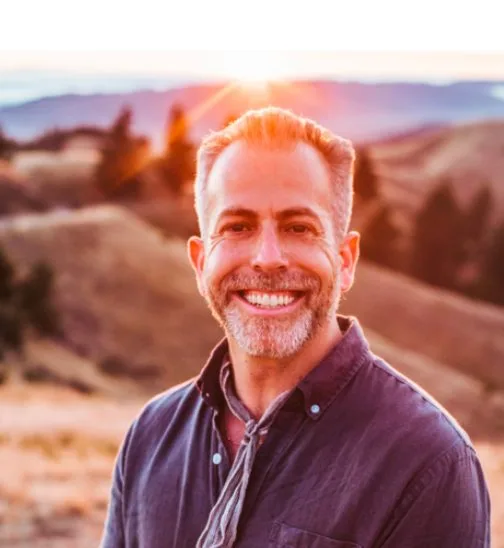
Day Schildkret
Author, Artist, Teacher
Day Schildkret is internationally renowned as the author, artist and teacher behind the Morning Altars movement, inspiring tens of thousands of people to make life more beautiful and meaningful through ritual, nature and art. BuzzFeed calls his work, “a celebration of nature and life.”
With nearly 100K followers on social media and sold-out workshops, installations, trainings, and public speaking events worldwide, Day is a thought-leader devoted to healing the culture by teaching people to ritualize the big and small moments of our work and our lives.
Day is the author of the up-coming book, Hello, Goodbye: 75 Rituals for Times of Loss, Celebration and Change (Simon Element), hitting #1 on Amazon for two days straight, as well as the author of Morning Altars: A 7-Step Practice to Nourish Your Spirit through Nature, Art and Ritual (Countryman Press).
Day has taught workshops and created installations at Google, The 9/11 Memorial Plaza, The Hammerstein Ballroom, The Andy Warhol Foundation, California Academy of Sciences, Esalen, and many others.
His work has been featured on NBC, CBS, Buzzfeed, Vice, Well+Good, My Modern Met and four times in Spirituality & Health Magazine. Find out more at https://www.dayschildkret.com