How a Year of Really Bad Dates Became a Very Good Jewish Story
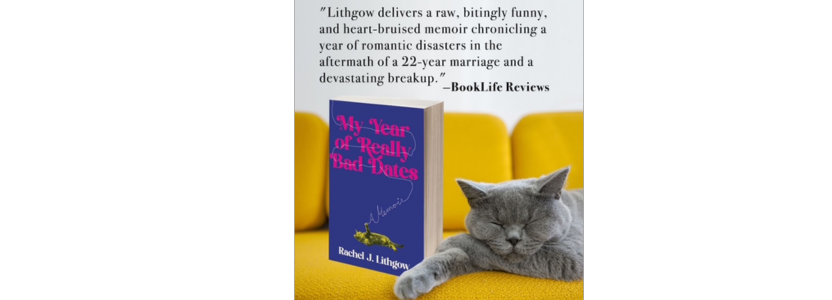

The new book, My Year of Really Bad Dates, mixes heartbreak, humor and a whole lot of chutzpah to turn romantic disaster into deeply Jewish art. In this candid and sharply funny memoir, Rachel J. Lithgow, a veteran of Jewish cultural life, shares how a Jewish lens shapes not just her love life, but her entire way of finding meaning (and comedy) in the chaos. She shares with Reboot a reminder that telling our stories, especially the messy ones, is a sacred act of survival and connection.
I have always written. When I was ten, my father bought me a tape recorder. I’m dating myself here, but it was a clunky thing with heavy buttons that I had to press hard to push, and I broke several nails in my attempt to record the soap opera I had written (I, of course, played all the characters). I wrote for the school paper in high school, a small, red-brick, blue-collar, idyllic-looking building with a bell tower, which gave it a real “High School USA” feel, until my English teacher, who hated me for writing a persuasive essay against the Iraq invasion, had me thrown off. In college, I got inventive in my blue books (there I go, dating myself again). I was reminded periodically that I was majoring in history and international relations, not creative writing. When I began my career as a Jewish professional running legacy Jewish museums and archives, I wrote scholarly articles and very professional op-eds to keep the institutions I was charged with relevant and in the collective consciousness of our community. In 2021, after more than 25 years, I left Jewish professional life (kind of, I have a consulting business for small Israeli NGOs that support Israeli civil society) to write full-time. I suppose I thought I’d write the great American novel, and certainly, at least in my estimation and according to my lovely agent, I wrote a helluva novel that has yet to be picked up by a publisher, but a book that I tossed off a first draft of in three months was, and here I am, encouraging you all to buy My Year of Really Bad Dates.
Why should you? Jewishness, in my memoir, isn’t just a background flavor for the book, andfrankly,it’s the main ingredient for everything I write. It’s the lens through which I see romance, disappointment, hope and humor. It’s the reason I have spent a lifetime laughing at my heartbreak and finding meaning in the messes, both that I have created and in the dumpster fire that Jews around the world now spend their days roasting inside of. If there is one thing my Yeshiva education taught me, it’s that even in the wilderness (or the wilds of dating, perimenopause, and navigating this thing we call “midlife”), you keep wandering, questioning, and most importantly, you keep telling the story.
But why focus on Jewish women’s stories, especially in a memoir dealing with romantic misadventure? Because for generations, Jewish women have been the keepers of tales-whispered over Shabbat candles, shouted across a crowded kitchen, or over a cocktail laced with wit, wisdom and a healthy dose of sarcastic skepticism. Our stories are the ones that remember the punchline and the pain, and the brisket recipe without raisins in it – because that’s nasty. To tell a Jewish woman’s story is to honor a legacy of resilience and reinvention. It’s to acknowledge that, yes, we can laugh at ourselves, at our yenta aunts, our own neuroses, at the time we drunkenly posted something outrageously inappropriate, and our rabbi commented (I can neither confirm nor deny). But it’s also to recognize the depth beneath the laughter: the longing for connection, the weight of tradition, the courage to keep searching for meaning (no disrespect to Frankl, but we search for it as well) in a world that lately feels like a cosmic joke.
Humor for the Jewish woman isn’t just a coping mechanism-it’s our superpower. It’s how we turn awkward silences into punchlines, how we transform disappointment into stories worth telling. And poignancy? That’s the secret ingredient. It’s what makes the laughter linger on the palate and what gives the legends their staying power. Because every joke about a bad date is also a testament to vulnerability, and to the continued belief that the next chapter might just be the game changer.
So the Jewish elements of this, my first memoir, aren’t just important, they are essential and the reason why my story is universal and also uniquely mine. I hope it illustrates that every woman’s voice matters, that every awkward encounter is worth chronicling, and that sometimes, the best way to survive a year of really bad dates is to keep on telling the story, one blessing, one punchline, one page at a time.
Rachel J. Lithgow is a historian and museum professional with thirty years of experience running large cultural institutions. Her work and writing have appeared in dozens of publications around the world, including The New York Times, The Daily News, Time, The Advocate, The Jerusalem Post, The Huffington Post, the Los Angeles Times, The Times of Israel, eJP, The New York Observer, and the Buffalo News. Rachel has two children and splits her time between Long Beach, Long Island, and Hell’s Kitchen in New York City. Order her book, My Year of Really Bad Dates.
Related