Painting as Language: Building the Set for Dis-order
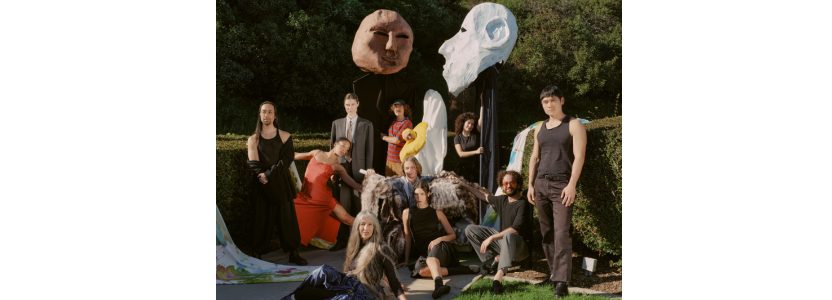

Artist and Reboot Network Member Ari Salka created the set design for the performance piece, Dis-order, at the Skirball Cultural Center in Los Angeles March 19 and March 20. A reimagining of the Passover Seder, the piece asks what forces move through us when we enact an ancient spring rite, and what is left unspoken when we gather around the table. The audience is seated around the periphery of a large, hollow triangular table, reminiscent of Judy Chicago’s “The Dinner Party.” The tablecloth by Salka forms the setting for an evolving installation and transforms the ritual dinner table into the visual and psychological core of the performance. Dis-order examines and pulls apart the traditions that we take for granted as part of the Passover ritual.
Painting as Language: Building the Set for Dis-order
By Ari Salka
I’ve been painting and drawing ever since I was a kid. I struggled with literacy because I have dyslexia, so I’ve always been drawn to color and abstraction as a way of communicating. I couldn’t read or write until third grade, so making marks on things and creating a visual language became my first language.
When I learned to read, a doctor supplemented each letter with a block that was associated with a different color, so I associated language and meaning with color, which has had a profound impact on how I communicate with others in the world.
I have always been influenced by action painting, which is a movement of artists whose work was interested in the gesture as much as it was the final product. The painting is the act of making marks on the page and the physical object that hangs in the museum after the making of the work is a trace or record of the art itself. It was the making that was most important to them, not the final painting.
This project is a collaboration with a dance company, a puppet company, and a writer, so it really feels like my work coming full circle and that I am creating a visual language to be used in a performance space. It’s been really exciting to see how my practice has shifted based on the collaboration. I created the set design for Dis-order, which is a piece of experimental theater loosely based on the Passover Seder, with a set inspired by Judy Chicago’s The Dinner Party, a large-scale installation of a triangular table in which there are place settings for important women throughout history.
The set design inspiration is a riff on this idea of giving folks a seat at the dinner table, except there are no place settings. It considers how no one has a seat at the table in contemporary American society, whereas Judy Chicago’s work referenced the lack of seats for important women throughout history. This piece is without place settings, so it’s not necessarily bringing people to the table in the way her work did. But then the audience is sitting at the table, so it’s sort of scrambling this idea of who gets a seat at the table and the hierarchy of the table, which is very much aligned with the vision of the entire piece and the title of the work, Dis-Order.
Dis-order examines and pulls apart the traditions that we take for granted as part of the Passover ritual. The piece also offers perspectives on contemporary family dynamics and spirituality in ways that one might not imagine when thinking about this important Jewish ritual. We’re taking tropes and symbols from history, religion, and mythology, as well as ideas from psychology, family systems, and religion and unpacking them and remixing them. In its own way, this is a reckoning with contemporary Jewish identity and the messy experience of living in the United States here and now.
In the set, I move in and out of loose figuration, abstraction, and washes, meditating on the themes that we explore in the work. While they’re being played out by the actors on stage and represented through the costumes and the puppets, the audience will also be interacting with them through this visual language of the table that they’ll literally be sitting at.
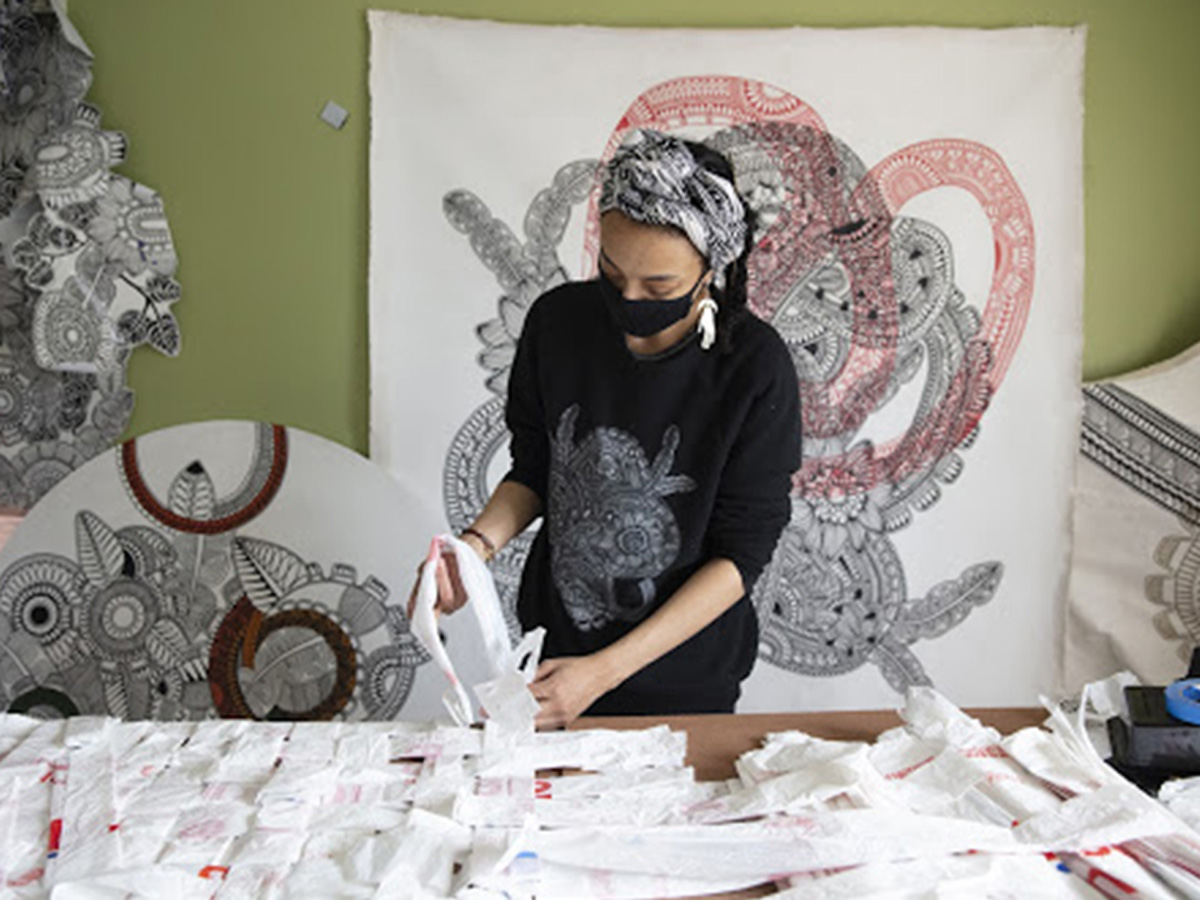
I’ve created over 700 feet of painted linen and treated it as an artist would a canvas. I then collaborated with fashion designer Ella Tiberi to cut and sew the linen into custom tablecloths for the set. It’s a departure from my previous way of working in that I am trying out new materials, like fabric dye, yet it’s also very much situated within my interest in process-based painting: because of the logistics of creating such a large amount of material, I haven’t seen all of the pieces of painting that I’ve created fabricated together into one piece while painting them. I won’t see them together until the day of the installation. This speaks to the scrambling of process that we’re exploring in this project: just as we are taking a traditional play, or dinner party and flipping it on its head, dissecting it and confusing it, I have also taken my painting process and fragmented it and reconstructed it into something that is no longer necessarily legible as a painting. Instead, it becomes something different for the audience to experience.
It’s a really rare opportunity for a fine art painter to collaborate with theater dance makers, because they so often work with traditional set designers. It has been an amazing opportunity for our entire team to work across disciplines in new ways that push us to consider our practices in relation to other disciplines, and also in relation to our Jewish identities. I see the set, and the paintings that make it up, as an offering or container for the performers and attendees to reflect on and fill in the blanks through their own lived experience.
Join Reboot and the Skirball Cultural Center in Los Angeles at Dis-order, March 19 and March 20. Get tickets.
*Disorder is presented with support from Reboot and will be touring in upcoming years.
Ari Salka (Set Design) is an artist working primarily working through painting, drawing, and poetry. Salka holds a BFA from the School of the Art Institute of Chicago and MFA in Painting from UCLA. Salka studied at the Yale Norfolk Summer School of Art and received the Ellen Battell Stoeckel Fellowship in Norfolk, CT. Salka’s work is featured in libraries and collections, including the LACA, the UCLA Arts Library, and the ROSA KWIR Archive in Mosta, Malta.
Related